Scott Martindale


  by Scott Martindale
  CEO, Sabrient Systems LLC

 Overview

Well, the FOMC followed the script and cut the fed funds rate (FFR) by 25 bps (from 4.25-4.50% range down to 4.00-4.25%) in an 18-1 vote. It was the first rate cut since December of last year—even though the rate needs to be 100 bps lower, in my view, as I have been advocating for quite some time, given the prior overreliance on government spending and hiring giving way to the growing impact of elevated rates on private sector growth and hiring, particularly within rate-sensitive industries. No more government largesse means the Fed must get busy with rate cuts. Market breadth was already improving in anticipation of the Fed’s dovish turn, with market segments like small caps, value stocks, banks, and transports perking up.

Although this was a relatively tepid move by the FOMC rather than the full-throated declaration of a new easing cycle that is needed, Fed chair Jerome Powell still believes monetary policy has officially shifted from "modestly restrictive" (his words at the July meeting) to "more neutral” today and characterized the latest rate cut as a "risk management" decision in light of slowing economic activity and jobs growth on the one hand, offset by sticky inflation on the other, which I discuss in greater depth in today’s post.

Of course, slashing FFR even 50 bps would give a panicky signal to the market, so newly appointed Fed Governor Stephen Miran was the lone dissenter, favoring 50 bps. Instead, they will proceed with gradual cuts on a steady path to eventually arrive at its long-term goal of a terminal FFR around 3.00% (2% inflation plus 1% neutral rate, aka “r-star”). The CME futures market now reflects 86% odds of two more 25-bp cuts this year (75 bps total for the year, bringing FFR down to 3.50-3.75%) and 78% odds of another two cuts next year (down to 3.00-3.25%)—as well as 50% odds of three cuts next year, despite the Fed’s own dot plot of two 25-bp cuts this year and just one in 2026. In my view, this will lead to more consumer spending, business borrowing for investment/capex, earnings growth, and stock buying (including retail, institutional, and share buybacks).

In response, the major indexes surged to new highs yet again. Any attempt at a pullback has been nothing more than an overbought technical correction/consolidation, as enthusiasm grows around the promise of AI revolutionizing our lives, workplace, and society at large, leading to rising productivity and prosperity. However, while we await the fully ripened fruits of these rapidly advancing technologies, stock gains have been driven more by multiple expansion in anticipation of great things to come, as well as a weaker dollar and surprisingly strong earnings growth—albeit driven more by cost-cutting and productivity growth than revenue growth, with net margins closing in on their 2021 peak of 13%.

Thus, lofty stock valuations and tight corporate bond spreads suggest an expectation that profitability and ROIC will remain strong for the foreseeable future despite the many storm clouds (such as geopolitical threats, ongoing hot wars, tariffs and unresolved trade negotiations, struggling global trading partners, sticky inflation metrics, weak jobs growth, social strife, and now a federal government shutdown). In fact, rather than investor fear manifesting in falling stock prices and rising market volatility, it instead seems to be reflected in the price of gold and silver, which have been surging.

Back in June, Mike Wilson of Morgan Stanley asserted, “we identified 4%-4.5% [on the 10-year yield] as the sweet spot for equity multiples, provided that growth and earnings stay on track.” Similarly, Goldman Sachs saw 4.5% acting as a ceiling for stock valuations. Wilson identified four factors that he believes would sustain market strength: 1) a trade deal with China (which China desperately needs sorted out), 2) stabilizing earnings revisions, 3) a more dovish Fed (i.e., rate cuts), and 4) the 10-year yield below 4% (without being driven by recessionary data). Indeed, all four have shown good progress.

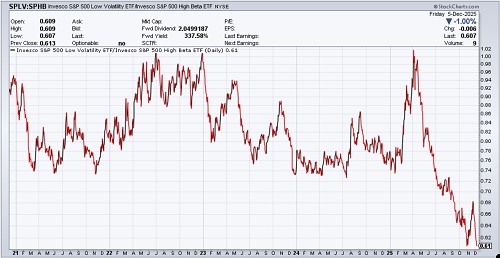
From the 4/7 lows, retail investors flipped from tariff panic to FOMO/YOLO, and the rest of the investor world has jumped onboard. Speculative “meme” stocks have been hot, and AQR’s Quality-minus-Junk factor (aka “quality margin”) has been shrinking. Moreover, small caps have been surging, as evidenced by the Russell 2000 Small-cap Index (IWM) setting new all-time high last week (for the first time since 2021), which is a historically bullish signal, and the Russell Microcap Index (IWC) has done even better. Similarly, value stocks also have perked up, with the Invesco S&P 500 Pure Value ETF (RPV) also reaching a new high, and the transports, like the iShares Transportation ETF (IYT), seems bent on challenging its highs from last November.

The broad market was long overdue for a healthy broadening to bolster bullish conviction, and indeed it appears the ducks finally lined up to support it. This broadening bodes well for further upside as capital merely rotates rather than leave the market entirely. The Carson Group has observed that for every time since 1980 that the Fed cut rates while the market was within 2% of an all-time high (21 instances), stocks continued to rise over the ensuing 12 months. As Eric Peters of One River Asset Management opined, “There is no appetite for austerity within either party, so their preference is for inflation-resistant assets, which [suggests]…stocks, gold, bitcoin.”

Overall, there is no magic here, the setup is bullish for stocks, with improving market breadth (i.e., wider participation), as we enter Q4. But that’s not to say we won’t get a pullback in the near term. Chart technicals show a relative strength index (RSI) that has been in overbought territory for a historically long time, but I think any significant pullback would be a buyable event. So, following two solidly bullish years, I think this year also will finish strongly, with a potential third-straight 20%+ year (total return, assuming dividends reinvested) in the crosshairs. But the cautionary tale is that, while not unprecedented, a third straight 20%+ year has only happened once before in the past 100 years, during 1995-99, i.e., when it ran for five straight years during the dot-com boom (followed of course by the dot-com bust). Also, while I expect longer-duration yields (and by extension, mortgage rates) to eventually recede, be careful about jumping too aggressively into them, as elevated yields might remain sticky until federal debt and inflationary pressures have shown that they are indeed moderating, as I expect they will by early next year.

Although corporate insider buying has been weak, share buybacks have already set an annual record and are on track to hit $1.1 trillion by year end. Also, investor appetite for IPOs has returned in force, with 259 IPOs on US exchanges through Q3 2025, which is up 75% versus the same point in 2024, reflecting an abundance of both investor optimism and liquidity. And Electronic Arts (EA) is officially going private in the largest leveraged buyout (LBO) in history, at $55 billion.

Furthermore, the Atlanta Fed’s GDPNow Q3 forecast has risen to 3.8% (as of 10/1), interest rates are coming down across the curve, the US economy is holding up, corporate earnings momentum remains strong, the CBOE Volatility Index (VIX) remains low, the Global Supply Chain Pressure Index (GSCPI) remains at or below the zero line (i.e., its historical average), global liquidity and M2 growth is modest/supportive, new tax rates and deregulation from the One Big Beautiful Bill Act (OBBBA) are supportive and stimulative, exciting new technologies are accelerating, strategic reshoring and supply chain redundancies are underway (but not total deglobalization), and secular disinflationary trends and productivity growth have resumed. The only thing missing is a fed fund rate (FFR) at the neutral rate—which is around 3.0%, in my view.

However, as I discuss in my full post below, cautionary signals abound, so investors should be tactically vigilant in this environment of rising valuation multiples, overbought technicals, sluggish corporate revenue growth (with strong earnings growth based on margin expansion from productivity growth and cost-cutting), rising bankruptcies and delinquencies, and falling Leading Economic Indicators by focusing on high-quality companies and diversification (across sectors and asset classes) while holding hedges (like protective put options or inverse ETFs).

Top-ranked sectors in Sabrient’s model include Technology, Financials, Industrials, which all seem poised to benefit from stimulus and capex tailwinds. With the 10-2 and 30-2 Treasury yield spreads currently at 56 bps (4.10-3.54%) and 117 bps (4.71-3.54%) respectively—the highest since early 2022—the steepening yield curve should be favorable for regional banks, which borrow short and lend long (so a higher spread leads to higher profits). Also top-ranked in our model is Healthcare based mostly on valuation, and it indeed might be a sleeper opportunity, as (according to DataTrek Research) “US large cap Healthcare has lagged the S&P 500 by more than 4 standard deviations, a level of underperformance we’ve never seen in a major sector.” And while Energy sits at the bottom of our Outlook rankings, the sector also has earned consideration based on firmer oil prices and disciplined capital plans.

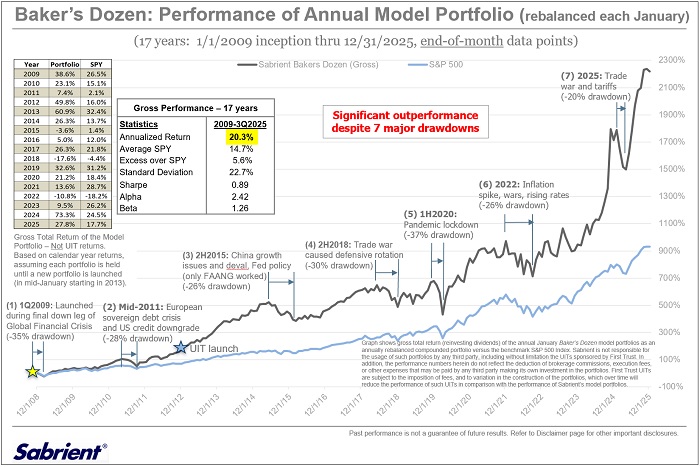
The Sabrient team focuses on fundamental quality—starting with a robust quantitative growth-at-a-reasonable-price (GARP) model followed by a detailed fundamental analysis and selection process—in selecting our Baker’s Dozen, Forward Looking Value, Dividend, and Small Cap Growth portfolios, which are packaged and distributed as UITs by First Trust Portfolios. By the way, the new Small Cap Growth (SCG 48) portfolio launches on Friday 10/3, so 10/2 is the final day to get into SCG 47, which is off to a good start, led by SSR Mining (SSRM) and Mercury Systems (MRCY) among its 44 holdings. The Q3 2025 Baker’s Dozen has also started off well, led by Sterling Infrastructure (STRL) and Valero Energy (VLO) among its 13 concentrated positions, as has our annual Forward Looking Value (FLV 13) portfolio. In fact, most of our 20 live portfolios are doing well versus their relevant benchmarks. Again, value and small caps seem like good ideas for a broadening market.

Notably, our proprietary Earnings Quality Rank (EQR) is a key factor used in our internal models, and it is also licensed to the actively managed First Trust Long-Short ETF (FTLS) as a quality prescreen. In fact, you can find our EQR score along with 8 other proprietary factor scores for roughly 4,000 US-listed stocks in our next-generation Sabrient Scorecards, which are powerful digital tools that rank stocks and ETFs using our proprietary factors. You can learn more about them by visiting: http://HighPerformanceStockPortfolios.com.

In today’s post, I discuss Fed policy, the modest inflationary pressures, the weak private sector jobs market, solid-but-fragile economic growth outlook, lofty stock valuations, and the case for value and small caps given emerging monetary and fiscal support. I also reveal Sabrient’s latest fundamental-based SectorCast quantitative rankings of the ten U.S. business sectors, current positioning of our sector rotation model, and several top-ranked ETF ideas. Click HERE to find this post in printable PDF format, as well as my latest presentation slide deck and my 3-part series on “The Future of Energy, the Lifeblood of an Economy.”

As always, please email me your thoughts on this article, and feel free to contact me about speaking on any of these topics at your event!  Read on….

  by Scott Martindale
  President & CEO, Sabrient Systems LLC

  As the New Year gets underway, stocks have continued their impressive march higher. Comparing the start of this year to the start of 2019 reveals some big contrasts. Last January, the market had just started to recover from a nasty 4Q18 selloff of about 20% (a 3-month bear market?), but this time stocks have essentially gone straight up since early October. Last January, we were still in the midst of nasty trade wars with rising tariffs, but now we have a “Phase 1” deal signed with China and the USMCA deal with Mexico and Canada has passed both houses of Congress. At the beginning of last year, the Fed had just softened its hawkish rhetoric on raising rates to being "patient and flexible" and nixing the “autopilot” unwinding of its balance sheet (and in fact we saw three rate cuts), while today the Fed has settled into a neutral stance on rates for the foreseeable future and is expanding its balance sheet once again (to shore up the repo market and finance federal deficit spending (but don’t call it QE, they say!). Last year began in the midst of the longest government shutdown in US history (35 days, 12/22/18–1/25/19), but this year’s budget easily breezed through Congress. And finally, last year began with clear signs of a global slowdown (particularly in manufacturing), ultimately leading to three straight quarters of YOY US earnings contraction (and likely Q4, as well), but today the expectation is that the slowdown has bottomed and there is no recession in sight.

As a result, 2019 started with the S&P 500 displaying a forward P/E ratio of 14.5x, while this year began with a forward P/E of 18.5x – which also happens to be what it was at the start of 2018, when optimism reigned following passage of the tax cuts but before the China trade war got nasty. So, while 2018 endured largely unwarranted P/E contraction that was more reflective of rising interest rates and an impending recession, 2019 enjoyed P/E expansion that essentially accounted for the index’s entire performance (+31% total return). Today, the forward P/E for the S&P 500 is about one full standard deviation above its long-term average, but the price/free cash flow ratio actually is right at its long-term average. Moreover, I think the elevated forward P/E is largely justified in the context of even pricier bond valuations, low interest rates, favorable fiscal policies, the appeal of the US over foreign markets, and supply/demand (given the abundance of global liquidity and the shrinking float of public companies due to buybacks and M&A).

However, I don’t think stocks will be driven much higher by multiple expansion, as investors will want to see rising earnings once again, which will depend upon a revival in corporate capital spending. The analyst consensus according to FactSet is for just under 10% EPS growth this year for the S&P 500, so that might be about all we get in index return without widespread earnings beats and increased guidance, although of course well-selected individual stocks could do much better. Last year was thought to be a great setup for small caps, but alas the trade wars held them back from much of the year, so perhaps this will be the year for small caps. While the S&P 500 forward P/E has already risen to 19.0x as of 1/17, the Russell 2000 small cap index is 17.2x and the S&P 600 is only 16.8x.

Of course, there are still plenty of potential risks out there – such as a China debt meltdown, a US dollar meltdown (due to massive liquidity infusions for the dysfunctional repo market and government deficit spending), a US vote for democratic-socialism and MMT, a military confrontation with Iran, or a reescalation in trade wars – but all seem to be at bay for now.

In this periodic update, I provide a detailed market commentary, offer my technical analysis of the S&P 500, review Sabrient’s latest fundamentals-based SectorCast rankings of the ten US business sectors, and serve up some actionable ETF trading ideas. In summary, our sector rankings look neutral, while the technical picture also is quite bullish (although grossly overbought and desperately in need of a pullback or consolidation period), and our sector rotation model retains its bullish posture. Notably, the rally has been quite broad-based and there is a lot of idle cash ready to buy any significant dip.

As a reminder, Sabrient now publishes a new Baker’s Dozen on a quarterly basis, and the Q1 2020 portfolio just launched on January 17. You can find my latest slide deck and Baker’s Dozen commentary at http://bakersdozen.sabrient.com/bakers-dozen-marketing-materials, which provide discussion and graphics on process, performance, and market conditions, as well as the introduction of two new process enhancements to our long-standing GARP (growth at a reasonable price) strategy, including: 1) our new Growth Quality Rank (GQR) as an alpha factor, which our testing suggests will reduce volatility and provide better all-weather performance, and 2) “guardrails” against extreme sector tilts away from the benchmark’s allocations to reduce relative volatility. Read on....

Scott Martindale  by Scott Martindale
  President, Sabrient Systems LLC

The major cap-weighted market indexes continue to achieve new highs on a combination of expectations of interest rate cuts and optimism about an imminent trade deal with China. Bulls have been reluctant to take profits off the table in an apparent fear of missing out (aka FOMO) on a sudden market melt-up (perhaps due to coordinated global central bank intervention, including the US Federal Reserve). But investors can be forgiven for feeling some déjà vu given that leadership during most of the past 13 months did not come from the risk-on sectors that typically lead bull markets, but rather from defensive sectors like Utilities, Staples, and REITs, which was very much like last summer’s rally – and we all know how that ended (hint: with a harsh Q4 selloff). In fact, while the formerly high-flying “FAANG” group of Tech stocks has underperformed the S&P 500 since June 2018, Barron’s recently observed that a conservative group of Consumer sector stalwarts has been on fire (“WPPCK”) – Walmart (WMT), Procter & Gamble (PG), PepsiCo (PEP), Costco (COST), and Coca-Cola (KO).

This is not what I would call long-term sustainable leadership for a continuation of the bull market. Rather, it is what you might expect in a recessionary environment. When I observed similar behavior last summer, with a risk-off rotation even as the market hit new highs, I cautioned that defensive stocks would not be able to continue to carry the market to new highs (with their low earnings growth and sky-high P/E ratios), but rather a risk-on rotation into cyclical sectors and small-mid caps would be necessary to sustain the uptrend. Instead, the mega-cap Tech names faltered and the market went into a downward spiral. Many analysts and pundits have been forecasting the same for this year.

But when I hear such widespread pessimism, the contrarian voice in my head speaks up. And indeed, the FAANG names – along with powerhouse Microsoft (MSFT) and cyclicals like Semiconductors, Homebuilders, and Industrials – have been showing leadership again so far this year, especially after that historic market upswing in June. Rather than an impending recession, it seems to me that the US economy is on solid footing and “de-coupling” from other developed markets, as First Trust’s Brian Wesbury has opined.

The US economic expansion just became the longest in history, the latest jobs report was outstanding, unemployment remains historically low, business and consumer confidence are strong, institutional accumulation is solid, and the Federal Reserve is a lock to lower interest rates at least once, and more if necessary (the proverbial “Fed Put”). Indeed, the old adages “Don’t fight the Fed!” (as lower rates support both economic growth and higher equity valuations) and “The trend is your friend!” (as the market hits new highs) are stoking optimism and a critical risk-on rotation, leading the S&P 500 this week to touch the magic 3,000 mark and the Dow to eclipse 27,000. If this risk-on rotation continues, it bodes well for Sabrient’s cyclicals-oriented portfolios.

In this periodic update, I provide a detailed market commentary, offer my technical analysis of the S&P 500, review Sabrient’s latest fundamentals based SectorCast rankings of the ten US business sectors, and serve up some actionable ETF trading ideas. In summary, our sector rankings look neutral to me (i.e., neither bullish nor defensive), while the sector rotation model retains a bullish posture. Read on…

Scott Martindaleby Scott Martindale
President, Sabrient Systems LLC

You might not have realized it given the technical consolidation in March, but Q1 2019 ended up giving the S&P 500 its best Q1 performance of the new millennium, and the best quarterly performance (of any quarter) since Q3 2009. Investors could be forgiven for thinking the powerful rally from Christmas Eve through February was nothing more than a proverbial “dead cat bounce,” given all the negative news about a global economic slowdown, the still-unresolved trade skirmish with China, a worsening Brexit, reductions to US corporate earnings estimates, and the Fed’s sudden about-face on rate hikes. But instead, stocks finished Q1 with a flourish and now appear to be poised to take another run at all-time highs. The S&P 500, for example, entered Q2 less than 4% below its all-time high.

Overall, we still enjoy low unemployment, rising wages, and strong consumer sentiment, as well as a supportive Fed (“Don’t fight the Fed!”) keeping rates “lower for longer” (and by extension, debt servicing expenses and discount rates for equity valuation) and maintaining $1.5 trillion in excess reserves in the financial system. Likewise, the ECB extended its pledge to keep rates at record lows, and China has returned to fiscal and monetary stimulus to revive its flagging growth stemming from the trade war. Meanwhile, Corporate America has been quietly posting record levels of dividends and share buybacks, as well as boosting its capital expenditures – which is likely to accelerate once a trade deal with China is signed (which just became more likely with the apparently-benign findings of the Mueller investigation). In addition, the bellwether semiconductor industry is presenting a more upbeat tone and an upturn from a cyclical bottom (due to temporary oversupply), while crude oil has broken out above overhead resistance at $60.

On the other hand, there is some understandable concern that US corporate earnings forecasts have been revised downward to flat or negative for the first couple of quarters of 2019. Of course, it would be preferable to see a continuation of the solid earnings growth and profitability of last year, but the good news is that revenue growth is projected to remain solid (at least 4.5% for all quarters), and then earnings is expected to return to a growth track in 2H2019. Moreover, the concurrent reduction in the discount rate (due to lower interest rates) is an offsetting factor for stock valuations.

All of this leads me to believe that economic conditions remain generally favorable for stocks. In addition, I think we may see upside surprises in Q1 and Q2 earnings announcements, especially given the low bar that has been reset. But it also may mean that investors will become more selective, with some stocks doing quite well even if the broad market indexes show only modest growth this year.

In this periodic update, I provide a market commentary, offer my technical analysis of the S&P 500, review Sabrient’s latest fundamentals-based SectorCast rankings of the ten US business sectors, and serve up some actionable ETF trading ideas. In summary, our sector rankings remain bullish and the technical picture suggests an imminent upside breakout, while the sector rotation model maintains its a bullish posture. Read on…

Scott Martindaleby Scott Martindale
President, Sabrient Systems LLC

The first two months of 2019 have treated Sabrient’s portfolios quite well. After a disconcerting 3Q2018, in which small-cap and cyclicals-heavy portfolios badly trailed the broad market amid a fear-driven defensive rotation, followed by a dismal Q4 for all stocks, the dramatic V-bottom recovery has been led by those same forsaken small-mid caps and cyclical sectors. All of our 12 monthly all-cap Baker’s Dozen portfolios from 2018 have handily outperformed the S&P 500 benchmark since then, as fundamentals seem to matter once again to investors. Indeed, although valuations can become disconnected from fundamentals for a given stretch of time (whether too exuberant or too pessimistic), share prices eventually do reflect fundamentals. Indeed, it appears that institutional fund managers and corporate insiders alike have been scooping up shares of attractive-but-neglected companies from cyclical sectors and small-mid caps in what they evidently saw as a buying opportunity.

And why wouldn’t they? It seems clear that Q4 was unnecessarily weak, with the ugliest December since the Great Depression, selling off to valuations that seem more reflective of an imminent global recession and Treasury yields of 5%. But when you combine earnings beats and stable forward guidance with price declines – and supported by a de-escalation in the trade war with China and a more “patient and flexible” Federal Reserve – it appears that the worst might be behind us, as investors recognize the opportunity before them and pay less attention to the provocative news headlines and fearmongering commentators. Moreover, I expect to see a renewed appreciation for the art of active selection (rather than passive pure-beta vehicles). However, we must remain cognizant of 2018’s lesson that volatility is not dead, so let’s not be alarmed if and when we encounter bouts of it over the course of the year.

Looking ahead, economic conditions appear favorable for stocks, with low unemployment, rising wages, strong consumer sentiment, and solid GDP growth. Moreover, Q4 corporate earnings are still strong overall, with rising dividends, share buybacks at record levels, and rejuvenated capital investment. So, with the Fed on the sidelines and China desperately needing an end to the trade war, I would expect that any positive announcement in the trade negotiations will recharge the economy in supply-side fashion, as US companies further ramp up capital spending and restate guidance higher, enticing risk capital back into stocks (but again, not without bouts of volatility). This should then encourage investors to redouble their current risk-on rotation into high-quality stocks from cyclical sectors and small-mid caps that typically flourish in a growing economy – which bodes well for Sabrient’s growth-at-a-reasonable-price (GARP) portfolios.

In this periodic update, I provide a market commentary, offer my technical analysis of the S&P 500, review Sabrient’s latest fundamentals-based SectorCast rankings of the ten US business sectors, and serve up some actionable ETF trading ideas. In summary, our sector rankings remain bullish, while the sector rotation model has returned to a bullish posture. Read on…

Scott Martindaleby Scott Martindale
President, Sabrient Systems LLC

After an “investor’s paradise” year in 2017 – buoyed by ultra-low levels of volatility, inflation, and interest rates, and fueled even more by the promise of fiscal stimulus (which came to fruition by year end) – 2018 was quite different. First, it endured a long overdue correction in February that reminded investors that volatility is not dead, and the market wasn’t quite the same thereafter, as investors’ attention focused on escalating trade wars and central bank monetary tightening, leading to a defensive risk-off rotation mid-year and ultimately to new lows, a “technical bear market” (in the Nasdaq and Russell 2000), and the worst year for stocks since the 2008 financial crisis. Then, it was confronted with the Brexit negotiations falling apart, Italy on the verge of public debt default, violent “yellow vest” protests in France, key economies like China and Germany reporting contractionary economic data, and bellwether companies like FedEx (FDX) and Apple (AAPL) giving gloomy sales forecasts that reflect poorly on the state of the global economy. The list of obstacles seems endless.

Moreover, US stocks weren’t the only asset class to take a beating last year. International equities fared even worse. Bonds, oil and commodities, most systematic strategies, and even cryptocurrencies all took a hit. A perfect scenario for gold to flourish, right? Wrong, gold did poorly, too. There was simply nowhere to hide. Deutsche Bank noted that 93% of global financial markets had negative returns in 2018, the worst such performance in the 117-year history of its data set. It was a bad year for market beta, as diversification didn’t offer any help.

Not surprisingly, all of this has weighed heavily upon investor sentiment, even though the US economy, corporate earnings, and consumer sentiment have remained quite strong, with no recession in sight and given low inflation and interest rates. So, despite the generally positive fundamental outlook, investors in aggregate chose to take a defensive risk-off posture, ultimately leading to a massive selloff – accentuated by the rise of passive investing and the dominance of algorithmic trading – that did huge technical damage to the chart and crushed investor sentiment.

But fear not. There may be a silver lining to all of this, as it has created a superb buying opportunity, and it may finally spell a return to a more selective stock-picker’s market, with lower correlations and higher performance dispersion. Moreover, my expectation for 2019 is for a de-escalation in the trade war with China, a more accommodative Fed, and for higher stock prices ahead. Forward valuations overall have become exceedingly attractive, especially in the cyclical sectors that typically flourish in a growing economy.

In this periodic update, I provide a market commentary, offer my technical analysis of the S&P 500, review Sabrient’s latest fundamentals-based SectorCast rankings of the ten US business sectors, and serve up some actionable ETF trading ideas. In summary, our sector rankings remain bullish, while the sector rotation model remains in a defensive posture. Read on…

Scott Martindaleby Scott Martindale
President, Sabrient Systems LLC

From the standpoint of the performance of the broad market indexes, US stocks held up okay over the past four weeks, including a good portion of a volatile June. However, all was not well for cyclicals, emerging markets (including China), and valuation-driven active selection in general, including Sabrient’s GARP (growth at reasonable price) portfolios. Top-scoring cyclical sectors in our models like Financial, Industrial, and Materials took a hit, while defensive sectors (and dividend-paying “bond proxies”) Utilities, Real Estate, Consumer Staples, and Telecom showed relative strength. According to BofA’s Savita Subramanian, “June was a setback for what might have been a record year for active managers.” The culprit? Macro worries in a dreaded news-driven trading environment, given escalating trade tensions, increasing protectionism, diverging monetary policy among central banks, and a strong dollar. But let’s not throw in the towel on active selection just yet. At the end of the day, stock prices are driven by interest rates and earnings, and both remain favorable for higher equity prices and fundamentals-based stock-picking.

Some investors transitioned from a “fear of missing out” at the beginning of the year to a worry that things are now “as good as it gets” … and that it might be all downhill from here. Many bearish commentators expound on how we are in the latter stages of the economic cycle while the bull market in stocks has become “long in the tooth.” But in spite of it all, little has changed with the fundamentally strong outlook underlying our bottom-up quant model, characterized by synchronized global economic growth (albeit a little lower than previously expected), strong US corporate earnings, modest inflation, low global real interest rates, a stable global banking system, and of course historic fiscal stimulus in the US (tax cuts and deregulation), with the US displaying relative favorability for investments. Sabrient’s fundamentals-based GARP model still suggests solid tailwinds for cyclicals, and indeed the start of this week showed some strong comebacks in several of our top picks – not surprising given their lower valuations, e.g., forward P/E and PEG (P/E to EPS growth ratio).

Looking ahead, expectations are high for a big-league 2Q18 earnings reporting season. But the impressive 20% year-over-year EPS growth rate for the S&P 500 is already baked into expectations, so investor focus will be on forward guidance and how much the trade rhetoric will impact corporate investment plans, including capex and hiring. I still don’t think the trade wars will escalate sufficiently to derail the broad economic growth trajectory; there is just too much pain that China and the EU would have to endure at a time when they are both seeking to deleverage without stunting growth. So, we will soon see what the corporate chieftains decide to do, hopefully creating the virtuous circle of supply begetting demand begetting more supply, and so on. Furthermore, the compelling valuations on the underappreciated market segments may be simply too juicy to pass up – unless you believe there’s an imminent recession coming. For my money, I still prefer the good ol’ USA for investing, and I think there is sufficient domestic and global demand for both US fixed income and equities, especially small caps.

In this periodic update, I provide a market commentary, offer my technical analysis of the S&P 500, review Sabrient’s latest fundamentals-based SectorCast rankings of the ten US business sectors, and serve up some actionable ETF trading ideas. In summary, our sector rankings still look bullish, while the sector rotation model has returned to a bullish posture as investors position for a robust Q2 earnings season. Read on....

By Scott Martindale
President, Sabrient Systems LLC

On Tuesday, March 21, the S&P 500 had its first 1%+ down-day of the year, and its first truly significant downward move in five months, falling -1.3% for the day, while the Russell 2000 small caps fell by an ominous -2.7%. For the S&P, it was the culmination of a -2.2% move over a 4-day period before stabilizing for a few days. But for the Dow, Monday of this week was its eighth straight losing day for the first time – its longest losing streak since 2011. The consensus bogeyman of course is the elusive passage of a new healthcare reconciliation bill and the fear that this exposes chinks in President’s Trump’s armor that may foreshadow delays in all his other fiscal stimulus proposals that have been so widely anticipated, and largely priced in. But I suggest focusing on the fundamental economic trends that are still solidly in place and not jump to conclusions about the future of external stimuli, some of which should enjoy broader bipartisan support. Maybe this is why the VIX has held defiantly below the important 15.0 level.

In this periodic update, I give my view of the current market environment, offer a technical analysis of the S&P 500 chart, review Sabrient’s weekly fundamentals-based SectorCast rankings of the ten U.S. business sectors, and then offer up some actionable ETF trading ideas. Overall, our sector rankings still look bullish, and the sector rotation model continues to suggest a bullish stance. Read on....

Scott MartindaleBy Scott Martindale
President, Sabrient Systems LLC

Investors continue to be sanguine about the economy and are reluctant to lighten up on stocks, even as we enter the New Year on the heels of a big post-election run-up, perhaps for fear of missing out on continued upside. Rather than fearing the uncertainty of a new (and maverick) administration, they instead have an expectation of a more business-friendly environment, fiscal stimulus, and a desirably higher level of inflation under Trump and a Republican-controlled congress. Stimulus likely would include lower corporate and personal taxes, immediate expensing of capital investment (rather than depreciating over time), incentives to repatriate offshore-held cash, reduced regulatory burdens, and infrastructure spending programs. Longer term, we also might see more favorable international trade deals and a freer market for healthcare coverage. Even the Fed is finally admitting that monetary stimulus alone can’t do the trick.

As the New Year gets underway, the technical picture remains strong, as the Dow is gathering strength to challenge ominous psychological round-number resistance at 20,000 and market breadth is impressive, led by small caps and value stocks. I believe we have a favorable environment for US equities going forward – especially fundamentals-based portfolios, like Sabrient’s annual Baker’s Dozen.

In this periodic update, I give my view of the current market environment, offer a technical analysis of the S&P 500 chart, review Sabrient’s weekly fundamentals-based SectorCast rankings of the ten U.S. business sectors, and then offer up some actionable ETF trading ideas. Overall, our sector rankings still look bullish, and the sector rotation model continues to suggest a bullish stance. Read on....

By Scott Martindale
President, Sabrient Systems LLC

On Wednesday afternoon, the Fed came through to fulfill what was widely expected – no change to the discount rate just yet. But it did pump up its hawkish language a bit. The FOMC never wants to surprise the markets, so given that it had not telegraphed a rate hike, it simply wasn’t going to happen. Looking forward, however, given that the committee sees the balance of economic risks at an equilibrium, a hike in December looks like a slam-dunk unless something changes dramatically. Beyond that, they are essentially telegraphing two rate hikes next year, as well. The upshot is that investors were happy and dutifully responded with a strong rally across many asset classes to finish off the day.

In this periodic update, I give my view of the current market environment, offer a technical analysis of the S&P 500 chart, review our weekly fundamentals-based SectorCast rankings of the ten U.S. business sectors, and then offer up some actionable ETF trading ideas.

Pages