Scott Martindale


  by Scott Martindale
  CEO, Sabrient Systems LLC

 Overview

Well, the FOMC followed the script and cut the fed funds rate (FFR) by 25 bps (from 4.25-4.50% range down to 4.00-4.25%) in an 18-1 vote. It was the first rate cut since December of last year—even though the rate needs to be 100 bps lower, in my view, as I have been advocating for quite some time, given the prior overreliance on government spending and hiring giving way to the growing impact of elevated rates on private sector growth and hiring, particularly within rate-sensitive industries. No more government largesse means the Fed must get busy with rate cuts. Market breadth was already improving in anticipation of the Fed’s dovish turn, with market segments like small caps, value stocks, banks, and transports perking up.

Although this was a relatively tepid move by the FOMC rather than the full-throated declaration of a new easing cycle that is needed, Fed chair Jerome Powell still believes monetary policy has officially shifted from "modestly restrictive" (his words at the July meeting) to "more neutral” today and characterized the latest rate cut as a "risk management" decision in light of slowing economic activity and jobs growth on the one hand, offset by sticky inflation on the other, which I discuss in greater depth in today’s post.

Of course, slashing FFR even 50 bps would give a panicky signal to the market, so newly appointed Fed Governor Stephen Miran was the lone dissenter, favoring 50 bps. Instead, they will proceed with gradual cuts on a steady path to eventually arrive at its long-term goal of a terminal FFR around 3.00% (2% inflation plus 1% neutral rate, aka “r-star”). The CME futures market now reflects 86% odds of two more 25-bp cuts this year (75 bps total for the year, bringing FFR down to 3.50-3.75%) and 78% odds of another two cuts next year (down to 3.00-3.25%)—as well as 50% odds of three cuts next year, despite the Fed’s own dot plot of two 25-bp cuts this year and just one in 2026. In my view, this will lead to more consumer spending, business borrowing for investment/capex, earnings growth, and stock buying (including retail, institutional, and share buybacks).

In response, the major indexes surged to new highs yet again. Any attempt at a pullback has been nothing more than an overbought technical correction/consolidation, as enthusiasm grows around the promise of AI revolutionizing our lives, workplace, and society at large, leading to rising productivity and prosperity. However, while we await the fully ripened fruits of these rapidly advancing technologies, stock gains have been driven more by multiple expansion in anticipation of great things to come, as well as a weaker dollar and surprisingly strong earnings growth—albeit driven more by cost-cutting and productivity growth than revenue growth, with net margins closing in on their 2021 peak of 13%.

Thus, lofty stock valuations and tight corporate bond spreads suggest an expectation that profitability and ROIC will remain strong for the foreseeable future despite the many storm clouds (such as geopolitical threats, ongoing hot wars, tariffs and unresolved trade negotiations, struggling global trading partners, sticky inflation metrics, weak jobs growth, social strife, and now a federal government shutdown). In fact, rather than investor fear manifesting in falling stock prices and rising market volatility, it instead seems to be reflected in the price of gold and silver, which have been surging.

Back in June, Mike Wilson of Morgan Stanley asserted, “we identified 4%-4.5% [on the 10-year yield] as the sweet spot for equity multiples, provided that growth and earnings stay on track.” Similarly, Goldman Sachs saw 4.5% acting as a ceiling for stock valuations. Wilson identified four factors that he believes would sustain market strength: 1) a trade deal with China (which China desperately needs sorted out), 2) stabilizing earnings revisions, 3) a more dovish Fed (i.e., rate cuts), and 4) the 10-year yield below 4% (without being driven by recessionary data). Indeed, all four have shown good progress.

From the 4/7 lows, retail investors flipped from tariff panic to FOMO/YOLO, and the rest of the investor world has jumped onboard. Speculative “meme” stocks have been hot, and AQR’s Quality-minus-Junk factor (aka “quality margin”) has been shrinking. Moreover, small caps have been surging, as evidenced by the Russell 2000 Small-cap Index (IWM) setting new all-time high last week (for the first time since 2021), which is a historically bullish signal, and the Russell Microcap Index (IWC) has done even better. Similarly, value stocks also have perked up, with the Invesco S&P 500 Pure Value ETF (RPV) also reaching a new high, and the transports, like the iShares Transportation ETF (IYT), seems bent on challenging its highs from last November.

The broad market was long overdue for a healthy broadening to bolster bullish conviction, and indeed it appears the ducks finally lined up to support it. This broadening bodes well for further upside as capital merely rotates rather than leave the market entirely. The Carson Group has observed that for every time since 1980 that the Fed cut rates while the market was within 2% of an all-time high (21 instances), stocks continued to rise over the ensuing 12 months. As Eric Peters of One River Asset Management opined, “There is no appetite for austerity within either party, so their preference is for inflation-resistant assets, which [suggests]…stocks, gold, bitcoin.”

Overall, there is no magic here, the setup is bullish for stocks, with improving market breadth (i.e., wider participation), as we enter Q4. But that’s not to say we won’t get a pullback in the near term. Chart technicals show a relative strength index (RSI) that has been in overbought territory for a historically long time, but I think any significant pullback would be a buyable event. So, following two solidly bullish years, I think this year also will finish strongly, with a potential third-straight 20%+ year (total return, assuming dividends reinvested) in the crosshairs. But the cautionary tale is that, while not unprecedented, a third straight 20%+ year has only happened once before in the past 100 years, during 1995-99, i.e., when it ran for five straight years during the dot-com boom (followed of course by the dot-com bust). Also, while I expect longer-duration yields (and by extension, mortgage rates) to eventually recede, be careful about jumping too aggressively into them, as elevated yields might remain sticky until federal debt and inflationary pressures have shown that they are indeed moderating, as I expect they will by early next year.

Although corporate insider buying has been weak, share buybacks have already set an annual record and are on track to hit $1.1 trillion by year end. Also, investor appetite for IPOs has returned in force, with 259 IPOs on US exchanges through Q3 2025, which is up 75% versus the same point in 2024, reflecting an abundance of both investor optimism and liquidity. And Electronic Arts (EA) is officially going private in the largest leveraged buyout (LBO) in history, at $55 billion.

Furthermore, the Atlanta Fed’s GDPNow Q3 forecast has risen to 3.8% (as of 10/1), interest rates are coming down across the curve, the US economy is holding up, corporate earnings momentum remains strong, the CBOE Volatility Index (VIX) remains low, the Global Supply Chain Pressure Index (GSCPI) remains at or below the zero line (i.e., its historical average), global liquidity and M2 growth is modest/supportive, new tax rates and deregulation from the One Big Beautiful Bill Act (OBBBA) are supportive and stimulative, exciting new technologies are accelerating, strategic reshoring and supply chain redundancies are underway (but not total deglobalization), and secular disinflationary trends and productivity growth have resumed. The only thing missing is a fed fund rate (FFR) at the neutral rate—which is around 3.0%, in my view.

However, as I discuss in my full post below, cautionary signals abound, so investors should be tactically vigilant in this environment of rising valuation multiples, overbought technicals, sluggish corporate revenue growth (with strong earnings growth based on margin expansion from productivity growth and cost-cutting), rising bankruptcies and delinquencies, and falling Leading Economic Indicators by focusing on high-quality companies and diversification (across sectors and asset classes) while holding hedges (like protective put options or inverse ETFs).

Top-ranked sectors in Sabrient’s model include Technology, Financials, Industrials, which all seem poised to benefit from stimulus and capex tailwinds. With the 10-2 and 30-2 Treasury yield spreads currently at 56 bps (4.10-3.54%) and 117 bps (4.71-3.54%) respectively—the highest since early 2022—the steepening yield curve should be favorable for regional banks, which borrow short and lend long (so a higher spread leads to higher profits). Also top-ranked in our model is Healthcare based mostly on valuation, and it indeed might be a sleeper opportunity, as (according to DataTrek Research) “US large cap Healthcare has lagged the S&P 500 by more than 4 standard deviations, a level of underperformance we’ve never seen in a major sector.” And while Energy sits at the bottom of our Outlook rankings, the sector also has earned consideration based on firmer oil prices and disciplined capital plans.

The Sabrient team focuses on fundamental quality—starting with a robust quantitative growth-at-a-reasonable-price (GARP) model followed by a detailed fundamental analysis and selection process—in selecting our Baker’s Dozen, Forward Looking Value, Dividend, and Small Cap Growth portfolios, which are packaged and distributed as UITs by First Trust Portfolios. By the way, the new Small Cap Growth (SCG 48) portfolio launches on Friday 10/3, so 10/2 is the final day to get into SCG 47, which is off to a good start, led by SSR Mining (SSRM) and Mercury Systems (MRCY) among its 44 holdings. The Q3 2025 Baker’s Dozen has also started off well, led by Sterling Infrastructure (STRL) and Valero Energy (VLO) among its 13 concentrated positions, as has our annual Forward Looking Value (FLV 13) portfolio. In fact, most of our 20 live portfolios are doing well versus their relevant benchmarks. Again, value and small caps seem like good ideas for a broadening market.

Notably, our proprietary Earnings Quality Rank (EQR) is a key factor used in our internal models, and it is also licensed to the actively managed First Trust Long-Short ETF (FTLS) as a quality prescreen. In fact, you can find our EQR score along with 8 other proprietary factor scores for roughly 4,000 US-listed stocks in our next-generation Sabrient Scorecards, which are powerful digital tools that rank stocks and ETFs using our proprietary factors. You can learn more about them by visiting: http://HighPerformanceStockPortfolios.com.

In today’s post, I discuss Fed policy, the modest inflationary pressures, the weak private sector jobs market, solid-but-fragile economic growth outlook, lofty stock valuations, and the case for value and small caps given emerging monetary and fiscal support. I also reveal Sabrient’s latest fundamental-based SectorCast quantitative rankings of the ten U.S. business sectors, current positioning of our sector rotation model, and several top-ranked ETF ideas. Click HERE to find this post in printable PDF format, as well as my latest presentation slide deck and my 3-part series on “The Future of Energy, the Lifeblood of an Economy.”

As always, please email me your thoughts on this article, and feel free to contact me about speaking on any of these topics at your event!  Read on….

Scott Martindale  by Scott Martindale
  President & CEO, Sabrient Systems LLC

 Key Points:

 1. The country’s 40-year path into a debt & deficit spending spiral was not working and had to change dramatically, not gradually, and the process to fix it is scary and uncomfortable.

2. The president’s “Liberation Day” tariff regime is at once simplistic and perplexing, but the selloff seems overdone, in my view, although the market remains fragile.

3. After an initial price shock, tariffs are deflationary like any tax; and countries are already coming to the table to negotiate them down.

4. The US is much less dependent on trade, less vulnerable to trade disruptions, and in far better position to weather a brief trade war than any other country, including mercantilist China, which is saber-rattling as a Trumpian bargaining tactic and to stoke the flames of political division in our country, in my view.

5. The $10 trillion that left the stock market was not lost like a wildfire burning down homes; it simply rotated into bonds and cash and can quickly rotate back if the outlook does not change and we have fiscal stimulus, supportive Fed, and rising global liquidity.

6. Volatility (up and down) may be sticking around through H1 until clarity improves later in the year.

7. For those still contributing to a 401(k), the selloff has presented a long-awaited opportunity to “buy low.”

8. Investors may be better served by active stock selection, such as Sabrient’s Baker’s Dozen, Small Cap, and Dividend portfolios.

Overview:

The news has been dominated by President Trump’s announced “Liberation Day” regimen of draconian tariffs, which are intended to induce both fairer trade policies from our trading partners and the onshoring of manufacturing. As his words moved from a 10% across-the-board baseline tariff (a nominal amount that initially sent stocks higher) to the gory details of his broader plan, the swan dive commenced. Negative volume went through the roof. Margin calls rained in. Algorithmic trading systems switched from leveraged long to either leveraged short or out of the market completely (thus removing critical liquidity), tripping stop losses and creating a cascade of selling pressure. The next day’s weekly AAII Sentiment Survey hit an extreme 62% bearish reading and will likely fall lower in this week’s survey. IPOs are being put on hold. The Polymarket odds of an emergency rate cut surged to 285, as did the odds of a rate cut meeting (36% at the May FOMC meeting but a 92% lock by the June meeting).

As of Monday morning’s open, the stock market had essentially given back all last year’s gains. Chartists are lamenting the failure of scary-bearish chart patterns (like the dreaded inverse flag pattern) that could potentially send stock indexes all the way down to their pandemic lows. The CBOE Volatility Index (VIX) surged above 45 on Friday 4/4 and then touched 60 in the pre-hours on Monday 4/7, which is reminiscent of the pandemic lockdown five years ago.

But are things today really as bad as that, when global supply chains were paralyzed and people were falling ill (and/or dying) en masse? I would say no, and in just a couple of blood-red, gap-down days, the rapid market meltdown already seems overdone, as I discuss further in today’s post. As famed value investor Ben Graham once said, “In the short run, the market is a voting machine, but in the long run it is a weighting machine.”

Although the VIX certainly could still go higher (perhaps a lot higher) and stocks lower, Friday looked to me a lot like capitulation and perhaps the start of a bottoming process leading to a great (and long-awaited) buying opportunity for long-term investors. Just be careful about “catching a falling knife.” Many countries (reportedly more than 50) have apparently reached out to fix their trade arrangements, although the biggie, China, is still in saber-rattling mode, at least for now.

Of course, the current selloff also was exacerbated by “priced for perfection” valuations and a complacent “buy every dip” mentality, largely driven by AI exuberance (and its promise of transformation disruption and rapid growth in productivity) and the massive capex allocated for AI infrastructure and datacenters. Furthermore, during the run-up to all-time highs in 2024, hedge funds had become more heavily leveraged long in US equities than at any time since the pandemic lockdown (as much 300% leveraged), essentially pulling forward gains from 2025 based on strong earnings expectations. So, there might be some similarities to the dot-com bubble bursting in 2001 in that respect. But even at its recent high, the overvaluation was nowhere near 1999 levels of the dot-com mania, and we don’t have the systemic credit and accounting issues leading into the 2008 Global Financial Crisis. Company balance sheets are quite sound, and although credit spreads have spiked, they remain low on a historical basis.

Even before the 4/2 tariff announcement, stocks were already looking shaky. It was fascinating to watch the charts of the major indexes like the S&P 500 ETF (SPY) and Nasdaq 100 ETF (QQQ) as they struggled for several days to hold support at the 300-day simply moving average, like a sloth hanging from a tree branch, until ultimately losing grip in dramatic fashion following the big tariff announcement. I opined in my March post that it might be time to create a shopping list of stocks but that volatility would likely continue into the tariff target date (4/2) and perhaps into Tax Day (as liquidity draws down for making tax payments). But few (including me) expected the cataclysmic selloff. Volatility may be sticking around for a while until clarity improves, particularly as Q1 earnings season (and forward guidance) kicks off this week.

To be sure, the reality of the new administration’s aggressive policies to fix many long-festering trade issues has caused much consternation and gnashing of teeth, drawn swift retaliation (particularly from China), disrupted global supply chains, lowered corporate earnings estimates, and raised recession risk (both domestically and globally). In response, just like when the so-called “bond vigilantes” short Treasury notes and bonds (or go to cash) in protest of rising budget deficits and total debt, the “stock vigilantes” went to work shorting stocks (or defensively moving to cash or Treasuries, removing market liquidity and briefly driving the 10-year yield below 4.0%) in protest of the uncertain impacts on the economy and corporate earnings. Or as former Democrat turned Trump supporter Batya Ungar-Sargon sees it, “Suddenly, everybody is sitting around saying, ‘Oh, no, the stock market!’ Yeah, the stock market looks like that because the rich [i.e., Wall Street institutional investors and hedge funds] are punishing Trump for siding with the neglected and humiliated American working class over them.” Indeed, the top 10% of Americans by income own 88% of stocks, the next 40% own 12%, and the bottom 50% are shut out.

So, yes, stock portfolios, IRAs, and 401(k) plans are way down, as the evening news keeps telling us. According to Bespoke Investment Group, the Russell 3000 has seen well over $10 trillion in lost market cap since Inauguration Day (1/20). However—and this is an important point—this is not “capital destruction” in the same sense that a wildfire can destroy homes and businesses. The capital pulled from the stock market didn’t vanish from the earth. It simply rotated into cash and bonds. And it very likely will return to stocks once trade situations are ironed out and visibility improves. It might take several months…or it could come back in a hurry. Be prepared. Perhaps start nibbling at stocks now. If you’re like me, you probably received a slew of low-price alerts for your target list. Some speculative investors might be going all-in at current levels. Regardless, for those still contributing to their IRA or 401(k) and not yet drawing on it, this selloff is a gift to be appreciated, in my view, restoring some value back into the market. After all, when you are in long-term accumulation mode, you want to “buy low.”

Of course, no one knows for sure how low it can go and when the selloff will bottom—and the bottoming process may be lengthy and volatile. The wild card for stocks going forward is uncertainty around the severity and duration of tariffs, which seem designed by their sheer audacity to induce a swift resolution. After all, there is no underlying malady in the economy that prevents business leaders and entrepreneurs from adapting like they always do, and only pride and prejudice can prevent a quick resolution to most of the trade arrangements.

Political, economic, and market volatility will surely continue during H1. But even if we get a larger correction than I expect, I continue to believe stocks will soon find support and ultimately give way to a gradual melt-up, sending the market to back near its highs of Q1 by year-end or early-2026, driven by rising global liquidity, a weaker US dollar, reduced wasteful/reckless government spending and regulatory red tape, lower interest and tax rates, massive corporate capex, and the “animal spirits” of a rejuvenated private sector and housing market. So, if you have been hoping and praying for lower prices in risk assets (including stocks and crypto) or for a lower mortgage rate to buy a house, you are getting them now, with the forward P/E on the S&P 500 at 18.7x as of 4/4 (before any significant downward revisions to earnings estimates), versus 22.7x at its February peak. As the poet Virgil once said (in Latin), audentes Fortuna iuvat” — i.e., “fortune favors the bold.”

Because this market correction was led by the bull market-leading MAG-7 stocks and all things AI related, investors now have a second chance to get positions in some of those mega-cap titans at more attractive prices. There remains a persistent sense among global investors of “American exceptionalism” based on ouir entrepreneurial culture, a tenacious focus on building shareholder value, and the mesmerizing appeal of our Big Tech companies that offer disruptive innovation, huge cash positions, reliable and consistently strong earnings growth, free cash flow, margins, return ratios, low interest-rate exposure, global scalability, and wide protective moats.

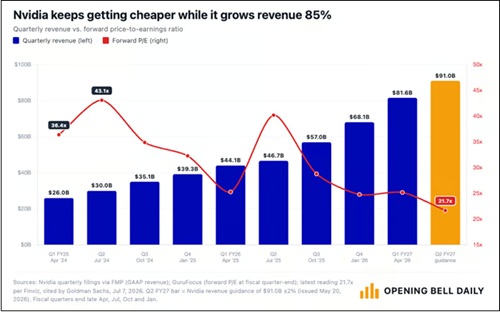
So, the initial recovery may well be led by the Big Tech titans that are now much more fairly valued, such as NVIDIA (NVDA) at a forward P/E of 21x (as of 4/4). Notably, some of these names have seen their valuations retreat such that they are once again scoring well in Sabrient’s growth models (as found in our next-gen Sabrient Scorecards subscription product)—including names like Amazon (AMZN), NVIDIA (NVDA), Salesforce (CRM), Alphabet (GOOGL), Meta Platforms (META), Microsoft (MSFT), Broadcom (AVGO), Oracle (ORCL), Arista Networks (ANET), Fortinet (FTNT), Palo Alto Networks (PANW), Palantir (PLTR), and Taiwan Semiconductor (TSM)—two of which (TSM and AMZN) are in the Q1 2025 Sabrient Baker’s Dozen.

But longer term, rather than the passive cap-weighted indexes dominated by Big Tech, investors may be better served by active stock selection that seeks to identify under-the-radar and undervalued gems primed for explosive growth—many of whom could coattail on the Big Tech names and provide greater returns. This is what Sabrient seeks to do in our various portfolios, all of which provide exposure to Value, Quality, Growth, and Size factors and to both secular and cyclical growth trends.

As for small caps, which as pointed out by Fama French used to outperform large caps over the long haul (higher risk, higher reward), the small cap indexes have been consistently lagging large cap indexes over the past 20 years, mostly due to their much lower allocation to the Technology sector. For example, the S&P 500 has a massive 17.6% relative overweight to the Tech sector (30.3%) versus the Russell 2000 (12.7%). And if you include the Tech-adjacent MAG-7 names that are categorized as Consumer Discretionary (i.e., Amazon and Tesla totaling 5.3%) and Communications (Alphabet and Meta Platforms totaling 6.4%), the S&P 500 allocation to the MAG-7 is 30.5%, and the combined Tech plus Tech-adjacent allocation is a whopping 42.0%—or a 28.9% relative overweight versus the Russell 2000!

Some might say that small caps are due for a mean reversion versus the S&P 500, but it seems its relative overweight to cyclical sectors like Industrials, Financials, Real Estate, Materials, and Energy (with only noncyclical/secular growth Healthcare having an overweight of 5.9%) rather than to secular growth Technology would make any attempt at mean reversion temporary. Nevertheless, I still think the small cap universe is where to find the most explosive growth opportunities (with the notable exception of large cap names like NVDA), even if the broad passive indexes (like Russell 2000) can't keep up. So, insightful active selection is important for small cap investing—which is easier to do given the relative lack of analyst coverage and institutional ownership of small caps.

We at Sabrient have become best known for our “Baker’s Dozen” portfolio of 13 diverse growth-at-a-reasonable-price (GARP) stocks, which is packaged and distributed quarterly to the financial advisor community as a unit investment trust through First Trust Portfolios, along with three other offshoot strategies based on Value, Dividend, and Small Cap investing. By the way, our Q1 2025 Baker’s Dozen remains in primary market until 4/16, after which time the Q2 portfolio launches. Also, our Small Cap Growth 45 portfolio remains in primary market until 4/21, followed by the launch of Small Cap Growth 46, and Dividend 51 is in primary market paying a 4.25% yield on new purchases.

As a reminder, Sabrient founder David Brown’s new book, How to Build High Performance Stock Portfolios, is available in both paperback and eBook versions on Amazon. And as a companion product to the book, we have launched next-gen versions of Sabrient Scorecards for Stocks and ETFs. You can learn more about the scorecards book and, download a sample scorecard, and sign-up for a free trial subscription—by visiting: http://DavidBrownInvestingBook.com/

In today's post, I examine in detail the new tariff regimen, the case for reducing (but not eliminating) the trade deficit, the liquidity challenge and “debt maturity wall,” and the case for tariffs and trade realignment. You won’t regret reading it through! I also discuss Sabrient’s latest fundamental-based SectorCast quantitative rankings of the ten U.S. business sectors, current positioning of our sector rotation model, and several top-ranked ETF ideas. Here is a link to this post in printable PDF format.  Read on….

  Scott Martindaleby Scott Martindale
  President, Sabrient Systems LLC

The market this year has been oscillating between fear and optimism, risk-off and risk-on. Until 8/27/19, risk-off defensive sentiment was winning, but since that date a risk-on sentiment has taken hold, and the historic divergence favoring secular growth, low-volatility and momentum factors, defensive sectors, and large caps (i.e., late-stage economic cycle behavior) over cyclical growth, value and high-beta factors, cyclical sectors, and small-mid caps (i.e., expansionary cycle behavior) continues to reverse, as fickle investors have become optimistic about at least a partial resolution to the trade war (including the lifting of tariffs), an improving outlook for 2020-21 corporate earnings, and resurgent capital investment. Investors have moved from displaying tepid and fleeting signs of risk-on rotation to full-blown bullish enthusiasm and reluctance to sell in a fear of missing out (FOMO), even though the short-term technical picture has become overbought.

The late-August risk-on rotation came in the nick of time. Last year at that same time of the year, the S&P 500 was marching higher until peaking on 9/20/18, but it was doing so on the backs of defensive sectors along with secular-growth Tech mega-caps, and I was opining at the time that the rally would fizzle if there wasn’t some rotation into the risk-on cyclicals and small-mid caps – which as you know didn’t happen, leading to the Q4 selloff. But, happily, this year has played out quite differently.

Nevertheless, a lot of successful fundamentals-based strategies (including powerhouse quant firm AQR Capital, discussed below) really took it on the chin for the roughly 14-18 months preceding 8/27, ostensibly due to fear that a “late-cycle” economy was on the verge of recession. And indeed it was becoming a self-fulfilling prophesy, as the dominos seemed to be falling one by one:  escalating trade wars creating uncertainty leading to a global manufacturing slowdown, a hold-off in corporate capital spending, and negative interest rates overseas, which pushed global capital into US debt, which temporarily inverted the yield curve, which brought out the doomsaying pundits – all of which was beginning to negatively impact the previously-bulletproof consumer sentiment that had been carrying US GDP growth.

But it was all based on false pretenses, in my view, and investors now seem to be convinced that the bottom is in for the industrial cycle and the corporate earnings recession, and particularly for prices of value/cyclical stocks with solid fundamentals. Results haven’t been as bad as feared, and some of the macro clouds are parting. Ultimately, stock prices are driven by earnings expectations and interest rates (for discounted cash flow valuation), and as the external obstacles hindering the free market are lessened or removed, the outlook brightens. And when investors focus on the fundamentals rather than the latest tweet, CNN headline, or single economic number taken out of context, it bodes well for Sabrient’s value-tilted GARP (growth at a reasonable price) portfolios, which of course includes our flagship Baker’s Dozen.

In this periodic update, I provide a detailed market commentary, offer my technical analysis of the S&P 500, review Sabrient’s latest fundamentals-based SectorCast rankings of the ten US business sectors, and serve up some actionable ETF trading ideas. In summary, our sector rankings still look neutral to me, while the longer-term technical picture remains bullish, and our sector rotation model retains a solidly bullish posture. Read on….

I don’t know about you, but I’m getting a lot of auto-response emails from folks in the investment world who are on vacation these days. Yes, the summer doldrums have set in, often leaving junior portfolio managers—without seniority, vacation time, school-age children, or much in the way of discretionary authority—to mind the store.

smartindale / Tag: CYH, ETF, Eurozone, GILD, IDU, iShares, IVR, IYC, IYE, IYH, IYI, IYJ, IYK, IYM, iyw, IYZ, linkedin, NLY, ORCL, sectors, SPY, STX, VIX / 0 Comments

Despite last week’s little rally, April showers have dampened market. While it didn’t build into a torrential downpour, it steadily showered investors with worse-than-expected economic data, including last week’s dreadful Durable Goods Report (-4.2% compared to last month’s +1.9%), continued but minor increases in initial jobless claims throughout April, and a disappointing initial Q1 estimate of GDP (+2.2% compared the previous quarter’s +3.0%).

david / Tag: AAPL, AGCO, EWP, GOOG, GS, GTE, IEV, ORCL, PAAS, STX, VGK / 0 Comments

Technology led today’s robust rally as the dollar continued to weaken. Financials, especially banks, remained strong the first three days of last week then fell to profit-taking on the final two days, ending down a little more than -0.5% for the week.  Today, that sector regained all of that loss and advanced an extra 25 basis points to reach near multi-year highs, although it is still more than 50% off its early 2007 high.

david / Tag: acn, DFS, DISCA, DKS, FDX, NKE, ORCL, TIF, VLO, VXX / 0 Comments

Bulls are trying mightily to ensure the Santa rally holds into year-end and close the year in the positive, as all eyes remain on Europe.

smartindale / Tag: AAPL, ETF, IDU, IYC, IYE, IYH, IYI, IYJ, IYK, IYM, iyw, IYZ, linkedin, MG, NBIX, ORCL, sector-rotation, sectors, SPY, UTHR, VIX / 0 Comments

Okay, Virginia, Maybe There is a Santa Claus . . .


david / Tag: AAPL, CF, HFC, ORCL, sectors, SHLD, UTHR / 0 Comments

Like the nice employer who never fails to pay a Christmas bonus every year, Santa seems bound and determined to give bulls the year-end rally they have come to expect. But bears aren’t going away quietly—although bulls got some unintended help from the bears with Tuesday’s short-covering-fueled rally.


smartindale / Tag: ANIK, ETF, IDU, IYC, IYE, IYH, IYI, IYJ, IYK, IYM, iyw, IYZ, linkedin, MNTA, ORCL, RBCAA, sector-rotation, sectors, SPY, WRLD / 0 Comments

Market Surges to 2-Month High--Why?

By David Brown, Chief Market Strategist, Sabrient Systems

david / Tag: AAPL, BAC, C, CAT, CI, GS, HS, HUM, JAZZ, ORCL, RNOW, SNX, VXX, WFC, WNR / 0 Comments

Pages